
By Olga Rakhmatulina, Independent Luxury Stone Advisor. ELITE STONE, USA
High-End Construction & Hospitality Projects
A Technical Perspective on Zone-Based Natural Stone Specification in Luxury Construction
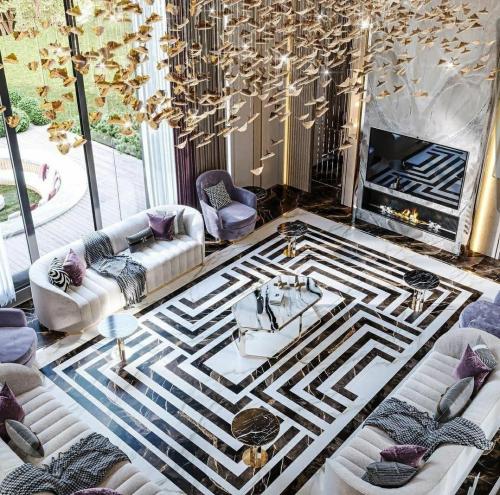
In high-end architecture, natural stone is often selected primarily for its visual character. However, performance failures in marble and other natural stones are rarely related to intrinsic material defects. More commonly, they arise from inappropriate specification relative to environmental exposure, structural demands, and installation systems.
Natural stone does not fail because it is “poor quality.”It fails when selected without reference to its physical and mechanical properties and the specific conditions of use. A zone-based specification approach is therefore essential in luxury and hospitality construction.
1. The Importance of Measurable Physical Properties
All natural stones used in construction must be evaluated according to standardized test methods. In Europe, these are defined under EN standards, while in North America, ASTM standards apply.
Key performance parameters include:
• Apparent density — EN 1936 / ASTM C97
• Water absorption at atmospheric pressure — EN 13755 / ASTM C97
• Open porosity — EN 1936
• Flexural strength under concentrated load — EN 12372 / ASTM C880
• Compressive strength — EN 1926 / ASTM C170
• Freeze–thaw resistance — EN 12371 / ASTM C666 (method adapted for stone)
• Abrasion resistance — EN 14157 / ASTM C241
• Slip resistance — EN 14231 / ASTM C1028 (withdrawn but referenced) or ANSI A326.3
Specification based solely on slab appearance, without reviewing these parameters, introduces long-term technical risk.
2. Spa & Hammam Environments: High Humidity and Thermal Cycling
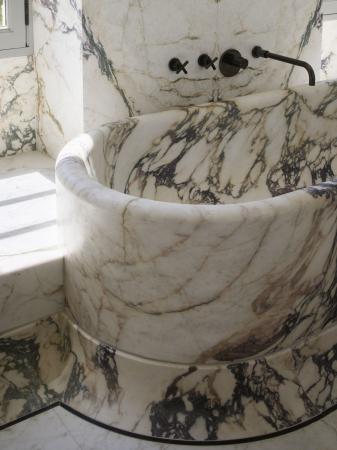
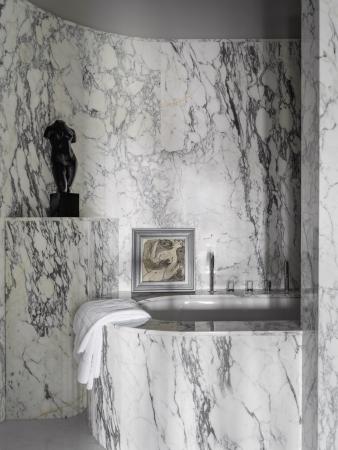
Spa areas, hammams, and steam rooms expose natural stone to:
• Continuous moisture saturation
• Elevated temperatures
• Repeated thermal expansion and contraction
• Aggressive cleaning agents
Technical considerations:
Water absorption ideally below 0.5% for heavy wet zones
Proper substrate waterproofing systems compliant with EN 14891
Flexible cementitious adhesives classified C2TE S1 or S2 under EN 12004
Movement joints designed in accordance with TCNA EJ171 (in U.S. practice)
Failure in these zones typically results from insufficient waterproofing or improper adhesive selection, rather than intrinsic marble weakness.
Dense calcitic marbles can perform exceptionally well when installed with correct detailing.
3. Exterior Facades and Freeze–Thaw Exposure
In temperate and cold climates, freeze–thaw durability becomes critical.
Water absorption combined with freezing temperatures can generate internal stress as water expands within pore structures.
EN 12371 testing evaluates frost resistance under cyclic conditions.
For exterior cladding:
Low absorption stones are preferable
Panel thickness is often ≥ 30 mm, depending on format
Mechanical anchoring systems must comply with structural codes
Stainless steel anchors (AISI 304 or 31,6 depending on exposure class) are recommended
In North America, the Marble Institute of America (Natural Stone Institute) Dimension Stone Design Manual provides additional guidance for facade anchoring and thickness.
The misconception that “all white marble behaves the same” often leads to inappropriate exterior applications.
4. Coastal Environments: Salt Crystallization Risk
Marine exposure introduces chloride-rich air and salt crystallization within pore structures.
Salt crystallization pressure can exceed the tensile strength of stone.
ASTM C88 (Sodium Sulfate Soundness) provides relevant insights into durability.
In coastal villas:
Lower porosity varieties should be prioritized
Breathable protective treatments may reduce ingress
Anchoring systems should use AISI 316 stainless steel
Material selection must account for environmental aggressiveness classification.
5. High-Traffic Hospitality Floors
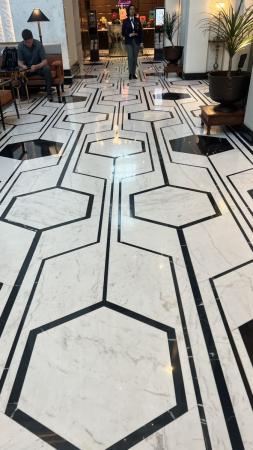
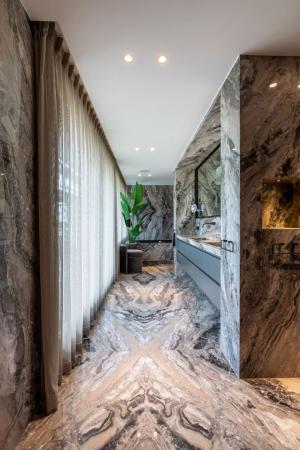
Luxury hotels present some of the most demanding operational environments:
• Constant pedestrian traffic
• Rolling luggage impact
• Frequent wet cleaning
• Repeated refinishing cycles
Relevant parameters:
Abrasion resistance (EN 14157)
Compressive strength (EN 1926 / ASTM C170)
Surface finish slip resistance (ANSI A326.3 dynamic coefficient of friction)
Polished marble may require slip mitigation strategies in wet areas.
Hotels evaluate materials based on lifecycle performance, not short-term aesthetics.
6. Structural Applications: Staircases and Load-Bearing Elements
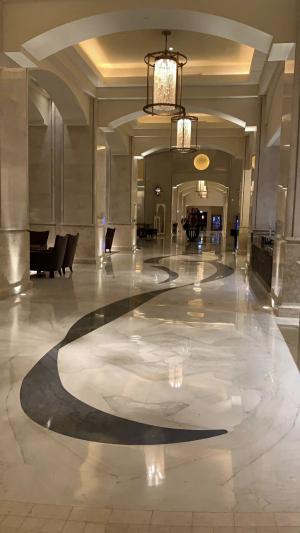
Marble stair treads and structural slabs must consider:
Flexural strength (EN 12372 / ASTM C880)
Span and support conditions
Live load requirements per local building codes
Thickness selection depends on:
• Span
• Support frequency
• Traffic intensity
Cracking often results from insufficient support or substrate deflection rather than stone deficiency.
7. Backlit Onyx Panels: Thermal and Mechanical Sensitivity
Onyx and translucent marbles require special consideration:
• Heat generated by LED systems
• Light diffusion uniformity
• Backing reinforcement
Thermal expansion compatibility between stone and lighting components must be considered.
Laminated systems or reinforced panels are commonly used to improve mechanical stability.
Improper lighting design may cause discoloration or stress concentration.
8. Hospitality Logic: Why Hotels Lead in Material Strategy
Hospitality developers operate on long-term operational models. Natural stone is preferred because:
• It is repairable and refinishable
• It contains no synthetic VOC emissions
• It maintains aesthetic value over decades
• It tolerates heavy maintenance cycles
Marble and travertine are not inherently antiseptic in medical terms. However, their mineral composition and non-organic nature make them compatible with high sanitation standards when properly maintained.
Hospitality environments often set the benchmark for private luxury residences.
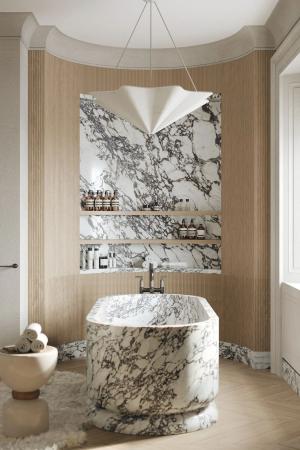
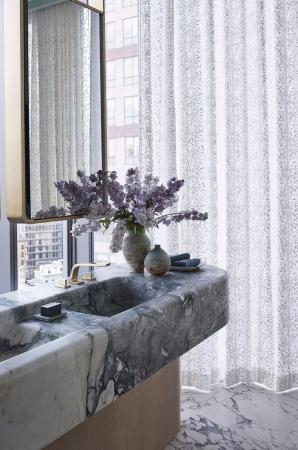
9. The Core Issue: Image-Based Approval
Many specification failures originate from:
• Approval based solely on a 10×10 cm sample
• Ignoring block movement and vein direction
• Overlooking environmental exposure
• Lack of coordination between the architect, the stone supplier, and the installer
Natural stone must be specified holistically — from quarry to installation.
Conclusion
Natural stone does not inherently succeed or fail.
Performance is contextual.
A zone-based strategy — grounded in standardized testing, environmental exposure assessment, and structural understanding — transforms marble from a decorative choice into an engineered architectural component.
The future of luxury construction depends not on selecting more exotic materials, but on specifying existing materials more intelligently.
