
Muhammed Mustafa Kan
KIYAMMAR Marble, Marmara Island, Turkey
The hidden risk in a beautiful marble photograph — and what the quarry can teach us about making better decisions.
Imagine a familiar exchange in the stone trade. A photograph arrives. The marble is beautiful: a pale surface, fine grey movement, just enough variation to make it unmistakably natural. A buyer replies with a single word: ‘Approved.’
The photograph may be accurate. The stone may be exactly what its supplier says it is. And yet that one word may conceal the beginning of a serious misunderstanding.
What, precisely, has been approved: the idea of a material, its acceptable range of natural variation, or the particular blocks and slabs that will be supplied?
Those are three different decisions. They are often treated as one.
A beautiful surface is not the whole stone
Marmara marble, quarried on Türkiye’s Marmara Island, is recognised for the interplay of light stone and grey markings. That character can appear restrained in one piece and more pronounced in another. A close-up may capture a subtle section while a full-size slab reveals a much stronger visual rhythm.
Neither image need be misleading. Each is showing a different amount of information.
This becomes especially important when a small sample is expected to represent a large wall, a sequence of panels or a substantial quantity of stone. What feels like a delicate detail in the palm of a hand can become a defining feature across a room.
At the quarry, the distinction is even clearer. A block is not a flat pattern waiting to be repeated. It is a volume of natural material. Its exposed faces can help reveal colour, banding and visible features, but they cannot disclose every characteristic of the interior before further processing. The appearance of cut slabs has to be assessed when that information becomes available.

Marmara Marble Equator (KIYAMMAR MARBLE)

Marmara Marble Homogeneous (KIYAMMAR MARBLE)
The three meanings of ‘yes’
The first ‘yes’ means: ‘I like the character of this stone.’ A small sample or an attractive photograph may be sufficient for that initial decision.
The second means: ‘I understand and accept the range of appearance that may be supplied.’ This calls for more than the most photogenic piece. Representative material images, variation in tone and markings, and a clear discussion of what would be acceptable become important.
The third means: ‘I approve these particular pieces for this particular use.’ If the project depends on a consistent sequence, adjoining panels or a specific arrangement, identifiable full-slab photographs and, where appropriate, a layout for approval can be far more useful than a product name alone.
A buyer may believe the third decision has been made when a supplier believes only the first has been made. The eventual disagreement is not necessarily about whether the stone is genuine. It is about whether everyone understood the same commitment.
What the quarry can explain — and what it cannot
Knowing the source of a stone can make a discussion more precise. Quarry photographs and block references help establish which material is under consideration and what can be observed before processing. They do not reveal every feature inside an uncut block.
Source information is valuable, but it is not a promise of uniformity. Examining the cut slabs remains essential, and suitability for a particular application requires separate consideration of the relevant technical requirements and evidence.
The most useful information is sometimes an honest limitation: this photograph shows one face; the wider range must be reviewed; these slabs have not yet been selected; that requirement needs separate verification.
Such answers may sound less impressive than a sweeping guarantee. In practice, they are often far more useful to the architect, processor or importer who must make a decision that remains sound after the material is cut and delivered.
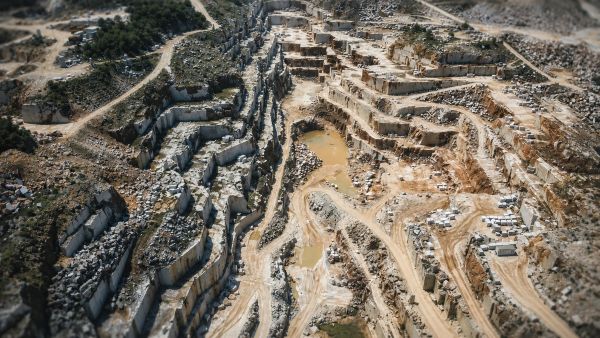
Marmara marble quarry (KIYAMMAR MARBLE)
Trust begins where the photograph ends
Natural stone is valued in part because it does not repeat itself perfectly. The objective is not to erase that individuality but to understand it well enough to use it deliberately.
A photograph can invite someone to fall in love with a marble. A responsible selection process must do the quieter work that follows: identify what is being considered, show the range that matters and record what has actually been approved.
The strongest promise in natural stone is not ‘Every piece will look the same.’ It is a shared understanding of what ‘the same’ needs to mean for the project at hand.
Contributed by KIYAMMAR Marble, Marmara Island, Türkiye. The contributor operates a marble quarry on Marmara Island.
