
Karen Abdallá, MARMONIL
“Standing beside the Pyramids, the Grand Egyptian Museum rises from the same earth — a modern monument carved from the story of stone itself.”
A Monument Carved from Egypt Itself
On November 1st, 2025, the world witnessed the unveiling of the Grand Egyptian Museum (GEM) — Egypt’s most anticipated cultural landmark and one of the most ambitious architectural undertakings of the century.
Set on the Giza Plateau, in the shadow of the ancient Pyramids, the museum has already earned the nickname “The Fourth Pyramid.”
Occupying nearly 500,000 m², the GEM is the largest archaeological museum in the world dedicated to a single civilization. Each year, millions will walk across its marble floors — quite literally, across the stones of Egypt.
“Every floor, façade, and walkway tells a geological story — one that begins deep within Egypt’s ancient quarries and culminates in this extraordinary space of light and history.”
The Grand Walkway — Path Between Eras
Framing the museum’s grandeur is the Grand Walkway, a breathtaking two-kilometre procession linking the Museum to the Great Pyramids. Geometric, angular, and monumental in scale, the Walkway reinterprets the timeless geometry of Giza in a modern architectural language.
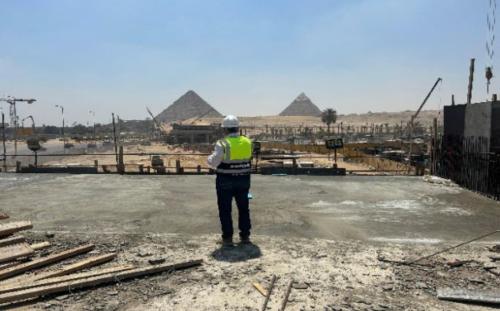
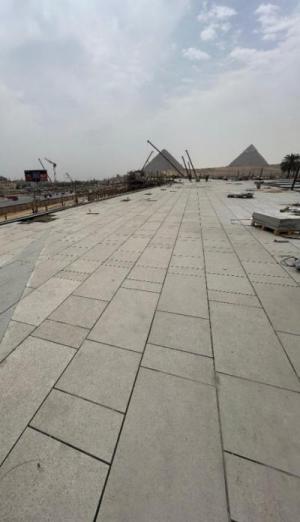
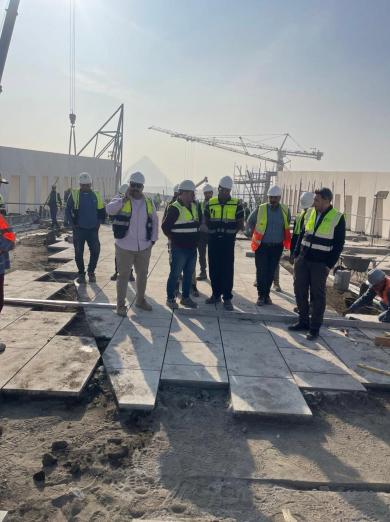
Executed in record time, the Walkway stands as a living symbol of Egypt’s capacity to blend past and present — a physical and emotional connection between the ancient and the modern.
Its stone composition tells a story of color and contrast:
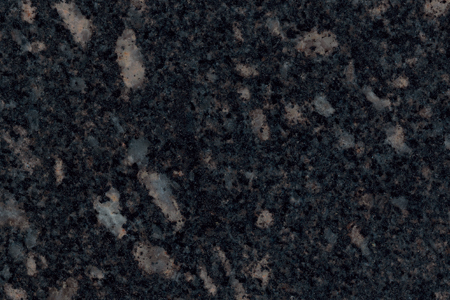
• Nero Aswan Granite — from Marmonil’s ancient Aswan quarry, the oldest in the world.
• Verdi Ghazal Granite — deep green-grey tones anchoring the space.
• Sinai Pearl Limestone — Egypt’s best-selling and most luminous limestone.
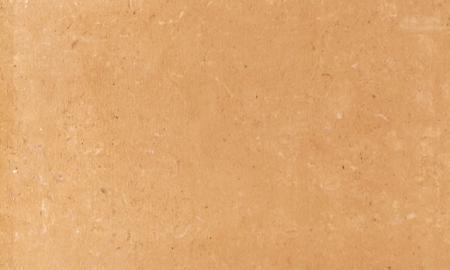
• Hashma Sandstone — adding warmth and texture to the palette.
Together, they create a rhythmic landscape of light and shadow — a choreography of materials inspired by Egypt’s own terrain.
Stone Palette: Egypt’s Natural Masterpiece
The museum’s material palette reflects Egypt’s geological and cultural identity:
• Verdi Ghazal Granite — a refined, warm green-grey granite that grounds the vast museum floors with quiet strength.
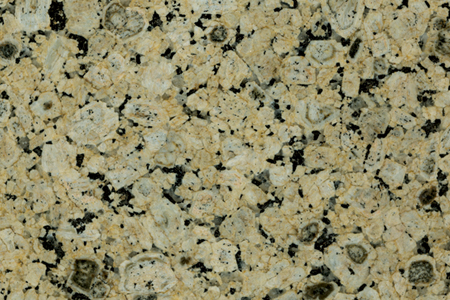
• Sinai Pearl Limestone — a luminous beige stone, timeless and elegant, dressing the façades and interiors.
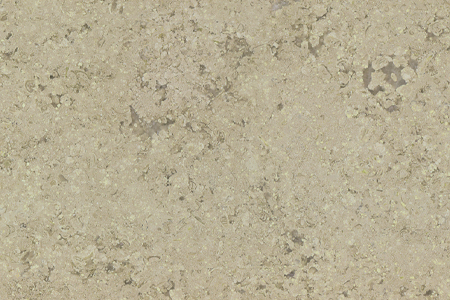
• Nero Aswan Granite — dramatic, ancient, and dignified, used in key architectural features.
• Hashma Sandstone — echoing the colors of Egypt’s desert dunes.
These stones were selected not only for durability but for symbolism — representing the layers of Egypt’s landscape and history.
Their interplay of color — the beige of the dunes, the green of the Nile, the black of ancient basalt — creates a visual rhythm as rich as the civilization it honors.
“Stone here is not a surface — it is a soul.”
The Powerhouses Behind the Stone
At the heart of this achievement stand two Egyptian titans of stone — Marmonil and HAZ Marble. Both are family-led companies, each with generations of expertise, innovation, and dedication to the craft of natural stone.
Marmonil, founded in 1963, is Egypt’s largest vertically integrated stone company, with quarries spanning the country and a reputation built on excellence, precision, and design.
HAZ Marble, part of the international HAZ Group, is a global leader in stone installation and engineering — known for its ability to deliver complex, technically demanding projects across continents.
Engineering the Impossible
The scale and complexity of GEM’s stonework demanded unprecedented technical mastery.
HAZ Marble, in joint venture with HAZ Mermer, designed, procured, and installed the intricate stone and steel substructures across more than 190,000 m² of façades, floors, and monumental features.
Key achievements included:
• Installing massive stone slabs on inclined steel structures along the north façades.
• Cladding the hanging obelisk in engraved double-black granite.
• Executing the Grand Staircase in Verdi Ghazal granite atop post-tensioned beams.
Each element was a feat of precision — merging engineering rigor with artistry.
Meanwhile, Marmonil supplied over 70,000 m² of Verdi Ghazal granite and Sinai Pearl limestone for the museum interiors, and another 41,000 m² for the Grand Walkway — from extraction to finishing, every piece traceable to its quarry of origin.
From Quarry to Landmark
Marmonil’s Aswan quarry, once the source of granite for ancient obelisks and temples, now contributes to the most modern museum of Egyptian civilization.
It is history completing its circle — the same stone, serving a new story.
“From the hands that cut the stone to the minds that placed it, the Grand Egyptian Museum is the meeting point of past, present, and precision.”
A Legacy Set in Stone
The Grand Egyptian Museum and its Grand Walkway are more than architectural marvels — they are monuments to Egypt’s eternal dialogue with stone.
“This project is not just built in Egypt — it is built of Egypt.”
Together, the two companies have set a new benchmark for collaboration, excellence, and national pride — a testament to how Egypt continues, quite literally, to move mountains.
Design & Project Team
Architects: Heneghan Peng Architects (Ireland)
Structural & MEP Engineers: Arup, Buro Happold, ACE Consulting Engineers
Landscape: West 8
Exhibition Design: Atelier Brückner
Project Management: Hill International & EHAF JV
Main Contractor: BESIX–Orascom Joint Venture
Stone Supply: Marmonil
Stone Installation & Engineering: HAZ Marble / HAZ Mermer JV
Client: Ministry of State for Antiquities, Supreme Council of Antiquities (SCA), and the Engineering Authority of the Armed Forces
Voices from the Project
Abit Yeşilkaya, CEO, HAZ Group:
“To see the stone of Egypt reborn in this way — at such scale and precision — is the proudest moment of our company’s history.”
Karen Abdalla, Managing Partner, Marmonil:
“From our quarries to the world’s greatest cultural landmark — this project is a celebration of Egypt’s earth, our people, and our enduring craft.”
