
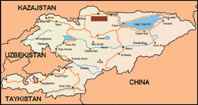
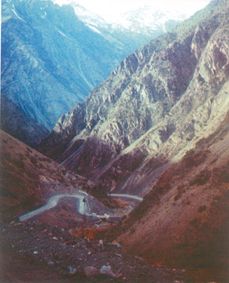
A Central Asian country of great natural beauty and proud nomadic traditions, Kyrgyzstan shares borders with Kazakhstan, Uzbekistan, Tajikistan and China. It is the farthest eastern Central Asian republic of the former Soviet Union. With an area of 198.500 km2 the landscape is rugged and mountainous - the average elevation is 2.750 m and almost 90% lies more than 1.500 m above sea level. Most of the 5 million or so population live in the valleys of the north and west. Agriculture (chiefly livestock farming) is the main activity. Kyrgystan has one of the largest proven gold reserves in the world. Other important natural resources include abundant hydropower, significant deposits of rare earth metals, nepheline, mercury, bismuth, lead and zinc, and locally exploitable coal, oil, and natural gas. Decorative stone reserves will be discussed at length later on. Manufactures include light machinery, metals and food products.
After seven decades of Soviet rule, Kyrgyzstan emerged as an independent state in August 1991. Since then it has been the most progressive country in Central Asia enacting market reforms, and adopting democratic principles. Kyrgyzstan was the first CIS country to be accepted into the WTO. GDP growth was 6% in 2003. However an estimated 50% of the population lived below the poverty line. President Askar Akayev and his government are addressing this and other problems.
Stone - ancient and modern
Stone implements found in the Tien Shan mountains indicate the presence of human society in what is now Kyrgyzstan as many as 200.000 to 300.000 years ago. Several hundred years ago, decorative stone was used to a limited extent in important buildings in Osh, Kyrgyzstan´s second and oldest city, and elsewhere.
Today prospected reserves of high, medium and low strength decorative stones total 44,1 million m3, including 15,8 million m3 of igneous rocks (granites, granodiorites, gabbro, syenites, etc.), 14,1 million m3 of marbles, hard limestones, conglomerates and dolomites, and 14,2 million m3 of limestones and shelly limestones.
On 01.01.2003, according to official sources, 165 deposits and manifestations of facing and decorative stones had been recorded by the Kyrgyz authorities and classified as of magmatic, sedimentary or metamorphic origin.
The first group includes granitoid deposits situated mainly in the northern part of the country and associated with Caledonian intrusions of the North Tien Shan folded system, a component part of the Urals-Mongolian geosyncline belt.
Effusive varieties are represented by porphyrites, porphyries, diabases, picrites and other rocks. This group of decorative stones is found mainly within the confines of the Kyrgyz, Talas and Chatkal mountain ridges, and the northern foothills of the Alai and Terskey-Ala-Too ranges.
Sedimentary rocks are mainly found in southern Kyrgyzstan, whilst metamorphic varieties occur predominantly in Talas and Osh regions.
The present and future outlook
Of the 165 deposits and manifestations of decorative stone officially registered in Kyrgyzstan, 10 have been evaluated in detail, 6 to a considerable degree, and the remainder to a lesser extent. There are thought to be 68 highly promising sites, 30 of which are in northern Kyrgyzstan. In mid-2004 only three deposits were being worked in a regular, stable manner.
An increase in reserves at the Kaindinskoye granitoid sources (Fig 1) in Talas district is possible in view of the contiguous sectors where decorative varieties of porphyritic granites occur. The Aralskoye and Kaindinskoye-1 deposits are in essence extensions of the main Kaindinskoye source. Reserves of decorative stones of magmatic origin in Talas district are enhanced taking into account the Sutti-Bulak (52 million m3), Dzhangi-Turmysh (6 million m3) and Sul-Bakair (15 million m3) deposits.
Concerning rocks of sedimentary genesis in the district, there are the limestones of Ichkeletau sector with estimated reserves of 21 million m3, and the decorative conglomerates of Dzhargart-1 with an estimated 12 million m3 of reserves.
The principle type of decorative stone worked by processing factories in Talas district is of metamorphic origin. The Ichkeletau group of marble deposits - Chaartash (Fig 2), Talas, Gulderek (Fig 3), Svetloye and Tashkoro - are of the greatest practical significance. The estimated reserves in this group of marble deposits, combined with the granitoid rocks at Kaindinskoye, situated 10 km to the north of a stone processing factory, could acquire great significance in the future.
The light blue-green marbles from Dzhargart (Fig 4) with estimated reserves of 90 million m3 are a promising resource.
Reserves of magmatic decorative stones in Ysyk-Kol district could be increased in the future through additional study of granite shows at Bokon-bayevo and Vostochno-Ysyk-Kol, where estimated reserves are considerable. In Ysyk-Kol district there is the Ak-Ulen deposit of highly decorative bluish-grey and pinkish-grey syenites, individual irising varieties of which are similar to the Spanish syenites " Azul Aran".
Regarding stones of sedimentary genesis in Ysyk-Kol district, reserves of the decorative conglomerates of Lower Carbonaceous age at Karator have been estimated at 4,3 million m3.
Among metamorphic rocks in the district, the Paleozoic hard limestones at Poloschatoye and the highly decorative listvenites at Uchkalskoye deserve further study. Other potential sources of highly decorative stones in Ysyk-Kol district include the Sartal, Tengi and Oyulma deposits with estimated reserves of 13,6 million m3, and carbonate rocks with interesting textural and colour varieties, including the black limestones at Tostu with reserves of 5 million m3, the limestone breccia at Padsha-Ata with reserves of 10 million m3, the zebra-like decorative dolomites at Kashkasu with estimated reserves of 4 million m3, and the brownish-grey limestones at Khodzhatush. There are an estimated 5 million m3 reserves of Paleozoic decorative conglomerates at Chanach, and at Shumkmazar with reserves of around 60 million m3. Reserves of red coloured jaspers in the region around Khodzhagair are estimated at hundreds of millions of cubic metres, whilst reserves of highly decorative carbonate-serpentine breccia at Shamatelskoye and Orusbulakskoye are estimated at 400 million m3. Variable colour porcelain jasper at Tashkumyrskoye is a new type of decorative stone.
As regards rocks of metamorphic genesis in the south of Kyrgyzstan, the white marbles of Akart, Abshir, Aksu, Ravat and other locations are of considerable practical interest. Magmatic rocks deserving further study include granites at Misken with estimated reserves of 2 million m3, Kochkorata - over 5 million m3, Kainama - 5 million m3, Koksarekskoye - 1 million m3, and other locations. Unusual varieties of decorative stone include the green variegated granitoids at Kyzyl-Kungei, the black picrites at Nadirskoye, the gabbroids at Zarkarskoye and Sartolinskoye, and the pyroxenites at Kachala.
In Naryn district, variegated syenites of Permian age within the Ortotokoi syenite massif and found at Arsy and Kyzyl-Ompul merit special attention. Of practical interest is the north-western sector of the Kyzyl-Ompul deposit where reserves of giant porphyritic syenites have been estimated at over 15 million m3.
In Osh and Jalal-Abad districts, a complex of sedimentary formations offers the best possibilties for decorative stone extraction. An increase in the recovery of shelly limestones has been possible for many years.
Short descriptions of the fully evaluated sources
Kaindinskoye, granodiorite & granite - Talas district
This
source is situated in Manass region, 50 km from Dzhambul railway
station and 390 km from Tokmak Stone Processing Factory, at a mean
height of 1300 - 1370 m. Two sectors are worked, situated 150 - 200 m
apart. The first sector comprises light grey granodiorites (Fig 1,a),
the second sector is made up of grey and pinkish-brown granites (Fig 1,
b and c). Licences for working both sectors are held by GAO
Kyrgyz-Too-Tash (Tokmak) and OOO GRANIT (Bishkek).
Kyrtyvalga, granite - Chu district
The Kyrtyvala deposit is in
Keminsk region, north-west of Ysyk-Kol and 60 km east of Tokmak, at an
absolute height of 1400 - 1530 m. An asphalt road from Tokmak to the
village of Ak-Tyuz passes within 2,5 km of the deposit. This consists
mainly of medium- and coarse grained sub-alkaline leucocratic granites
of pinkish-grey, pink, or brownish-red colour (Fig 5). The
possibilities for extending the site are practically limitless. This
deposit is not being worked at present. The hydro-geological conditions
at the site are favourable.
Gulderek, marble - Talas district
The Gulderek coloured marble
deposits are to be found in Bakai-Atin region, 4 km north of Ming-Bulak
village at an absolute height of 1110 - 1255 m, and 45 km from a
railway line. The marble formations extend to 170 m depth. The mainly
medium crystalline marble is banded and may be of various colours -
light grey, grey, greenish-grey and dark grey, grey-green, and
variegated (Fig 3). All the marbles from this source take a mirror
polish. The deposits are currently being worked and provide a raw
material base for the Tokmak Stone Processing Factory in Tokmak and the
Ivanovsk Stoneworks, also in Tokmak.
Chaartash, marble - Talas district
The Chaartash deposit is in
Bakai-Atin region, 7 km north of Klyuchevka village at an absolute
height of 1630 - 1765 m. The distance to Tokmak Stone Processing
Factory is 423 km, and it is 81 km to Dzhambul railway station. The
formations being worked are fine crystalline, variegated pink, black,
creamy-grey banded marbles (Fig 2). The deposit is being held in
reserve - it is fully prepared for quarrying.
Aralskoye, granite - Talas district
This source in Talas
district is just 45 km from a railway line. The stone is a medium grain
grey granite. Reserves are in excess of 20 million m3. Blocks comprise
40% of the material extracted.
Akart, marble - Osh district
This source of white marble is in
Naukat region, 30 km south of the hamlet of Yangi-Naukat, at an
absolute height of 2700 - 2880 m and 35 km from a railway line. This is
a coarse grain, dense white marble - the seam is around 90 m deep. The
deposit is prepared for quarrying.
Ak-Ulem, syenite - Ysyk-Kol district
This deposit is 18 km from
a railway line. The syenite is medium grain, porphyritic, highly
decorative, grey and pinkish-grey. There are 1,3 million m3 of
reserves. The yield of blocks from the rock mass can be up to 65%. Some
irising varieties are analogous to the Spanish syenites " Azul-Aran ".
The quarry is worked from time to time.
Sary-Tash, shelly limestone - Osh district
This source is in
Uzgen region, 80 km east of the city of Osh, at an absolute height of
1940 - 2200 m. From the deposit to the main Osh-Uzgen highway is 35 km,
it is 70 km on a gravel road to the nearest railway station at Karas.
There are three layers of the shelly limestone totalling 13,2 m in
depth. The material can be brownish-yellow or yellowish-white in colour
(Fig 6), with an appearance similar to walnut wood. It can be polished
to a glossy finish. This deposit is worked by the company AO
Osh-Ak-Tash of Tokmak.
Arym (Chichkan), marble - Jalal-Abad district
These marble formations are found in Toktogul region, 28 km from the town of Toktogul, at an absolute height of 1460 - 1700 m. The Bishkek - Osh highway passes within 100 m of the site, it is 155 km to Tashkumyr railway station on the Central Asia line, 200 km to Karabalta station on the Kyrgyz Railways line, and 324 km to Tokmak Stone Processing Factory.
There are two sectors of this deposit, Arym-I and Arym-II, situated 200 m apart. The marble is intersected with microdiorite dykes. Arym marble comes in grey, light grey, bluish-grey and greenish-grey colours with a spotted, banded or homogenous texture (Fig 8). This source is worked by GAO Kyrgyz-Too-Tash company.
All the deposits described above are in favourable geographic locations, and can be worked by standard quarrying methods. Of these 9 deposits with adequate reserves for long-term working, only three are continually operated at the present time - Kaindinskoye, Arym and Sary-Tash. The Gulderek coloured marble and Akart white marble quarries are worked irregularly. Some deposits - Ak-Ulem, Bozbutoo and Chaartash - are worked intermittently by local companies. The remaining sources have been prepared for quarrying and are being held in reserve. In Kadamzhai region there is a small quarry of coloured marbles (Fig 10) at Tashbolot. The firms OOO Granit and GOK Dzhamgyr Resource (both based in Bishkek) also extract blocks intermittently from Kyrgyz quarries.
Stone processing - current situation
The main facilities processing natural decorative stones on an industrial scale in Kyrgyzstan today are Tokmak Stone Processing Factory (owned by GAO Kyzyl-Too-Tash) and Osh Stone Processing Works (owned by OOO Osh-Too-Tash), and also Ivanovsk Stoneworks which is administered by the North Kyrgyzstan Geological Prospecting Institute.
The Tokmak factory produces slabs, tiles and memorial products. This factory is equipped with Soviet and Italian machines (delivered between 1976 and 1982) which are practically worn out. The current annual production of slabs is: granite - 10.000 m2, marble - 25.000 m2, and limestone - 30.000 m2. Due to a lack of orders, the Tokmak factory only works one shift a few days a week.
Considering the ancient traditions of stone use in Kyrgystan, and the very considerable resources as outlined in this report, it is to be hoped that the decline in production will be arrested in time so that the Republic can take its rightful place amongst the decorative stone producers of the Commonwealth of Independent States (CIS).
*Abrigded version of a report published in Imperiya Kamnya
(Empire of Stone), September 2004 issue and translated from the Russian
by Paul Daniel.
